Estimate the field.
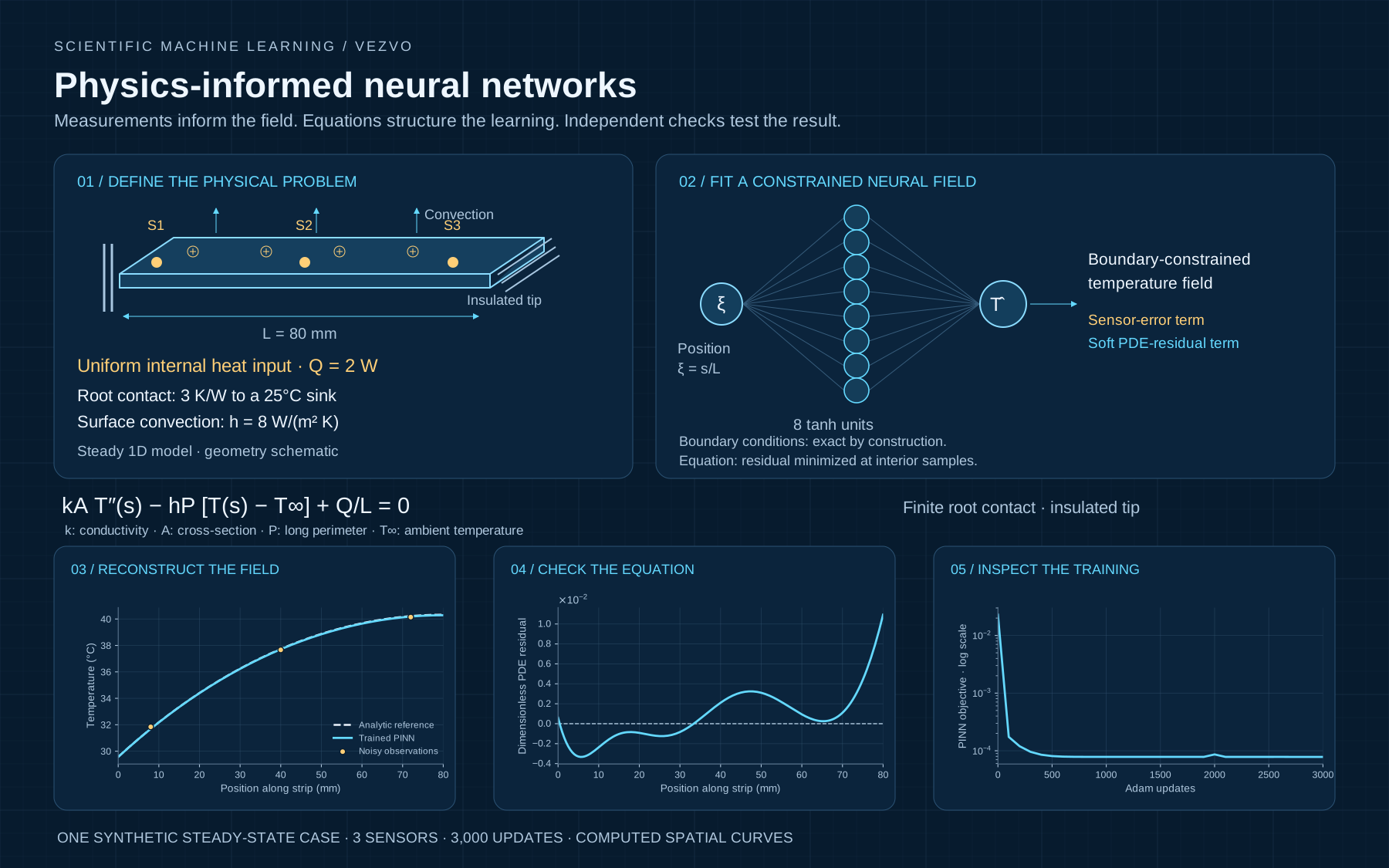
Fit temperature to sparse observations while reducing the heat-equation residual. Check the spatial profile against an independent reference.
Scientific machine learning
Synthetic 1D thermal benchmark
Combine sparse observations with stated physical equations to reconstruct fields, investigate uncertain parameters and plan measurements.
THE OPPORTUNITY
A few sensors leave much of an engineering system unobserved. Different physical explanations may fit the same readings, especially when heat input, interfaces or measurement locations are uncertain.
THE FIELD BETWEEN THE MEASUREMENTS
A physics-informed neural network represents a differentiable field and combines observations with the residual of a stated equation. Its usefulness depends on the physical model, the available measurements and independent checks.
Fit temperature to sparse observations while reducing the heat-equation residual. Check the spatial profile against an independent reference.
Investigate uncertain contact and heat input. Several parameter combinations may fit the same readings; a small misfit does not establish a unique explanation.
Compare sensor locations using a declared local sensitivity model, then examine the proposed layout in a new synthetic experiment.
A DEFINED SYNTHETIC BENCHMARK
A steady one-dimensional metal strip has uniform internal heating, surface convection, finite thermal contact to a cooled root and an insulated far end.
The benchmark makes reconstruction, identification and measurement planning inspectable. A chip package, changing workload or three-dimensional device needs its own model and validation.
Explore the thermal learning studySparse synthetic observations train the networks. The dense analytic field checks predictions; field error is not a training target or stopping rule.
The PINN satisfies its two modeled boundary conditions by construction. The equation residual is minimized at sampled interior points; a small residual alone does not guarantee accuracy.
PINN parameter learning assumes known heating power. The separate physical-model grid treats power and contact resistance as unknown. Its near-fit region is not a confidence interval.
Learned temperature, analytic reference and noisy observations use position in millimeters and temperature in degrees Celsius. The profile is spatial, not a time waveform.
The dimensionless residual measures departure from the stated heat balance. It is distinct from temperature error and sensor misfit.
The curve records the combined PINN objective after optimizer updates. It is a training diagnostic, not calibrated uncertainty or proof of performance on other systems.
Scientific background: Raissi, Perdikaris & Karniadakis — physics-informed neural networks; Wang, Teng & Perdikaris — training limitations.
POTENTIAL APPLICATIONS
Research opportunities to assess for a defined use case.
Study temperature profiles and uncertain thermal interfaces with sparse measurements and an appropriate thermal model. A device-specific extension needs measured power, boundary conditions and independent validation.
Investigate whether sensor evidence can distinguish a parameter change from a different heat input or an incomplete model. Compare competing explanations before assigning a fault or changing operation.
Compare candidate sensor locations before an instrumented prototype or test campaign. Use declared planning assumptions, then check whether the resulting measurements improve identifiability in practice.
INTERACTIVE RESEARCH PREVIEW
THE QUESTION TO TEST
Compare sparse and clustered sensors, train both models, then inspect alternative contact-resistance and heat-input fits.
A synthetic steady 1D thermal benchmark with uniform internal heating, surface convection, a finite root contact and an insulated tip. Field learning, one-parameter PINN inference, a separate two-parameter physical fit and local sensor planning have distinct assumptions. No measured-device accuracy or general PINN advantage is claimed.
Explore a related direction.
Connected Environmental SensingRESEARCH · DEVELOPMENT · CONSULTING
Outline the use case, available evidence and intended outcome.
Prepare a project brief