Test quantum features.
Investigate circuit-defined features, kernels and observables against the needs of a learning task and suitable classical alternatives.
Quantum information & machine learning
Classical simulation of quantum workflows
Study quantum features for learning and classical optimization of quantum workflows, with explicit comparison baselines.
THE OPPORTUNITY
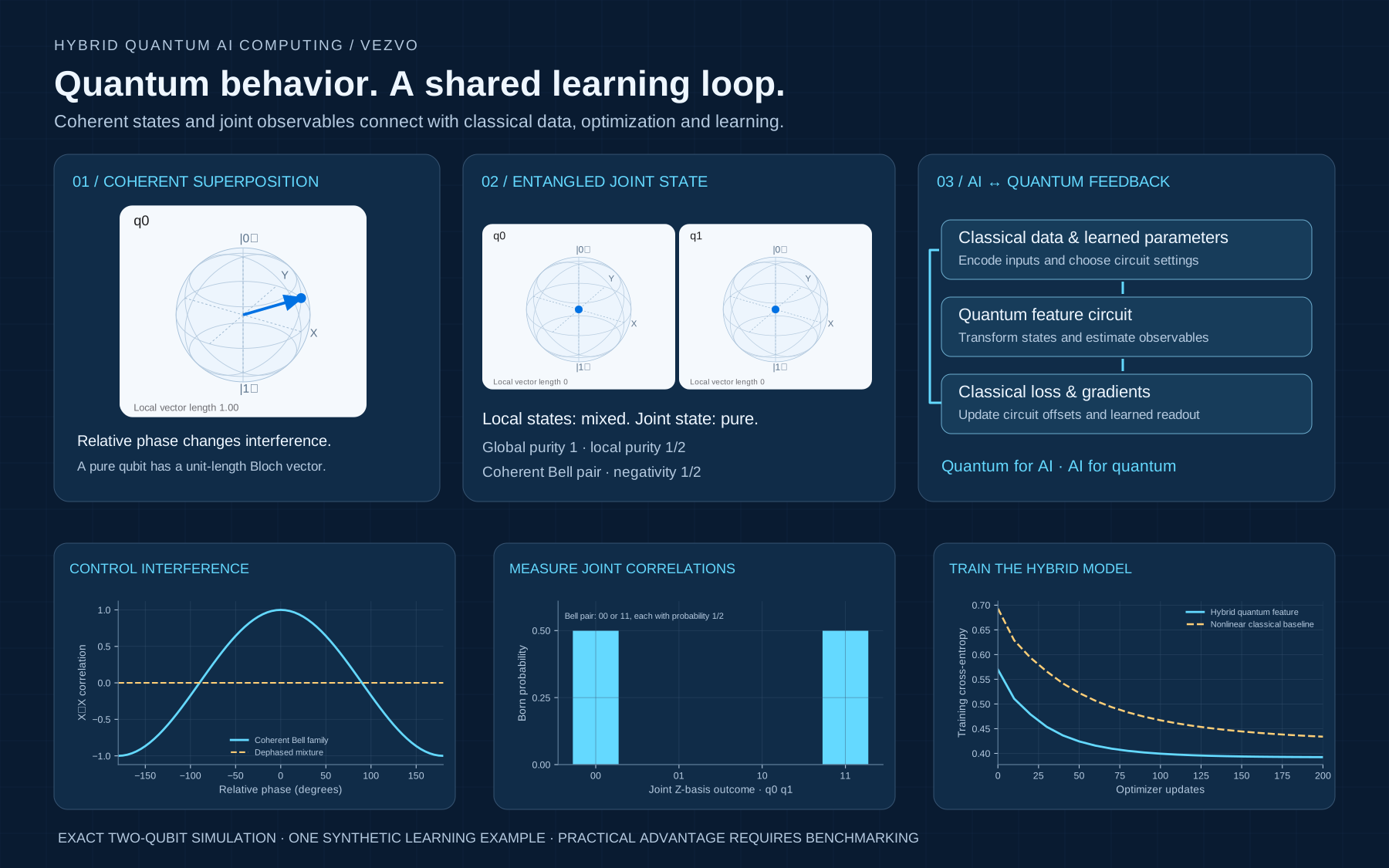
Quantum systems represent and transform coherent joint states. Classical AI can learn parameters, choose experiments and interpret observations. The opportunity depends on matching the quantum resource to a useful task and an accessible data source.
A RECIPROCAL RESEARCH OPPORTUNITY
Coherent states, interference and joint correlations offer representations to investigate. Classical optimization and learning can tune circuit parameters and help select or interpret measurements.
Investigate circuit-defined features, kernels and observables against the needs of a learning task and suitable classical alternatives.
Explore learned circuit choices, noise characterization and experiment selection. Hardware calibration and control require experimental data.
Combine quantum subroutines, classical models and independent checks. Evaluate quality, resource use and robustness over the complete task.
THE BEHAVIOR BEHIND THE OPPORTUNITY
Relative phase can change interference and outcomes in a suitable measurement basis. It is not an extra classical bit waiting to be read.
An ideal Bell pair is globally pure while each qubit is locally maximally mixed. Joint correlations reveal structure absent from two independent pure-state pictures.
An n-qubit pure state has 2ⁿ amplitudes. A computational-basis measurement yields one sampled bit string per shot; it does not reveal every amplitude at once.
EVALUATE THE POSSIBILITIES
An advantage must improve a defined task against capable classical baselines after input preparation, circuit execution, measurement and classical processing are counted. Independent test data, noise and resource budgets belong in that comparison. The locally simulated two-qubit classifier illustrates the workflow; it does not establish practical quantum advantage.
Scientific context: quantum feature learning, parameter-shift gradients, and the role of data and classical comparison.
POTENTIAL APPLICATIONS
Research opportunities to assess for a defined use case.
Explore circuit-defined features, quantum kernels and quantum-native observables for a suitable learning problem. Compare useful prediction quality, data preparation and full resource costs.
Investigate learned calibration, experiment selection and noise characterization using appropriate device observations. Couple classical learning with the quantum controls and measurements that matter.
Study how quantum state or energy evaluations could interact with learned models in materials, chemistry and scientific search. Each application needs its own algorithm, physical model and validation.
INTERACTIVE RESEARCH PREVIEW
THE QUESTION TO TEST
Explore phase, basis and entanglement. Then train the hybrid classifier and compare held-out results with the nonlinear classical baseline.
All quantum behavior is simulated locally on a classical computer. Explore exact two-qubit states, a trainable quantum-feature classifier with an independent synthetic test set and nonlinear classical baseline, plus a supporting allocation study. These demonstrations do not establish hardware performance or general quantum advantage.
Explore a related direction.
Physics-Informed AIRESEARCH · DEVELOPMENT · CONSULTING
Outline the use case, available evidence and intended outcome.
Prepare a project brief