Power and function.
Relate regulated rails, conversion losses, interconnects and computing demand. Examine temperature-dependent resistance.
Electronics & computational engineering
Reduced coupled-model study
Explore interactions among electrical demand, heat removal and mechanical contact across an electronics platform.
THE OPPORTUNITY
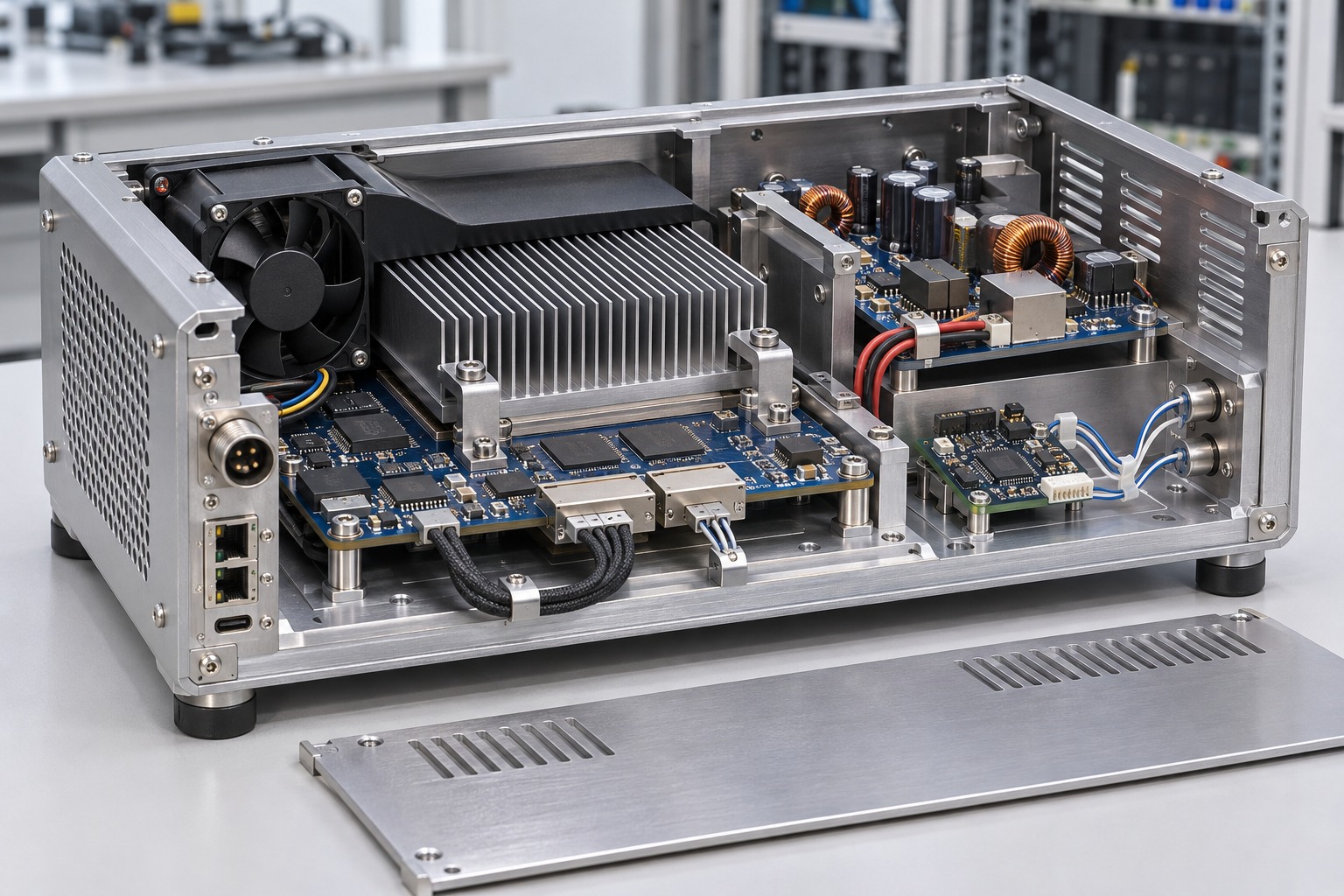
Dense edge AI, power electronics and intelligent machines bring high electrical demand, limited cooling space and mechanical constraints into one assembly. A local improvement can shift loads, temperatures or interface conditions elsewhere.
DESIGN THE ELECTRONICS AS A SYSTEM
Computing, conversion, sensing, cooling and structural support share a limited volume. The design question is how their interactions change the whole system under different operating conditions.
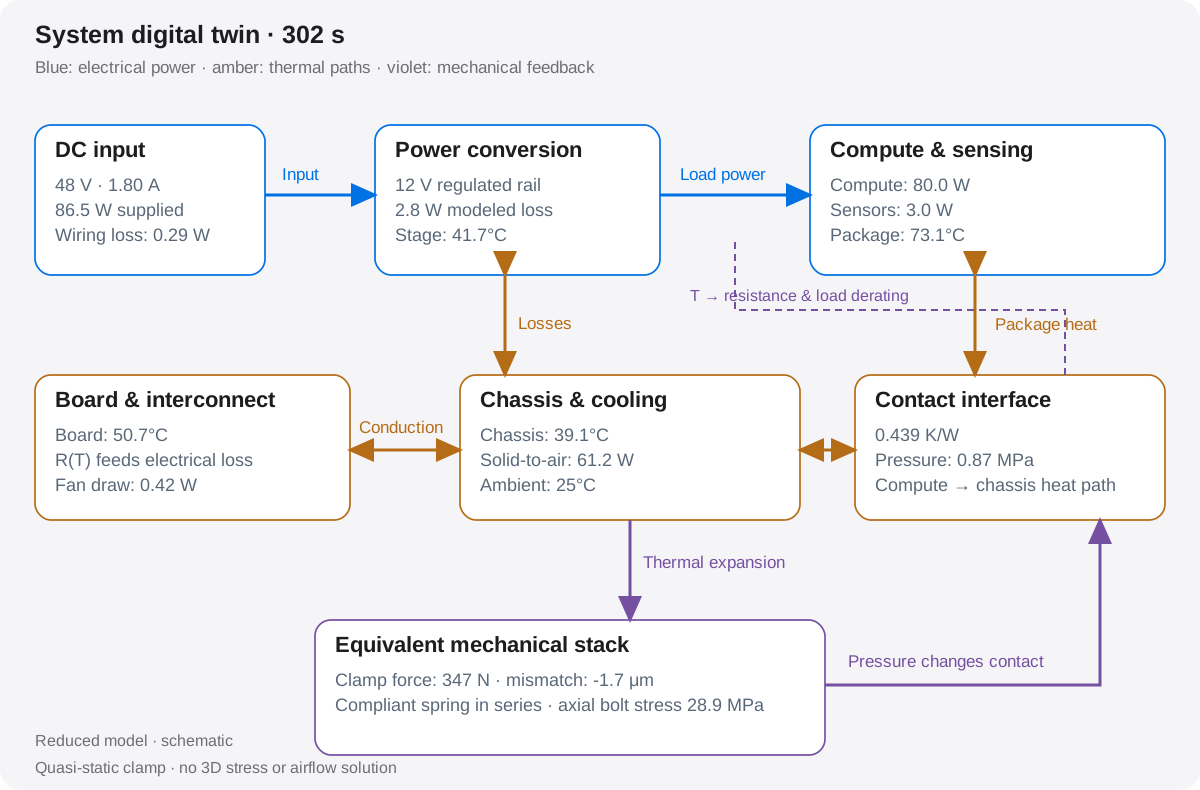
Relate regulated rails, conversion losses, interconnects and computing demand. Examine temperature-dependent resistance.
Connect packages, interfaces and the chassis to cooling boundaries. Assess contact resistance and heat-removal capacity.
Follow differential expansion, clamp stiffness and load paths. Changing contact pressure can change thermal resistance.
Explore how observations, workload policies and cooling commands change demand and physical response.
THE COUPLED MODEL
Electrical loss raises temperature. Differential thermal expansion changes clamp force and contact resistance. The resulting temperature changes electrical loss and may trigger modeled workload derating.
DEVELOPMENT PATH
Future work can link calibrated models, detailed circuit, airflow and structural analyses, and instrumented prototypes. The current system network, board field, design comparison and rigid alignment studies have separate assumptions. Reliability prediction, full three-dimensional coupling and twins connected to operating equipment require dedicated data and independent validation.
POTENTIAL APPLICATIONS
Research opportunities to assess for a defined use case.
Study compute bursts, power conversion, package cooling and enclosure support together for industrial edge computers, robot controllers and autonomous sensing platforms.
Investigate conversion losses, interconnect heating, cooling interfaces and mounting concepts for compact converters, energy-control electronics and electrified equipment.
Connect system architecture with environmental and mechanical test planning for industrial, communications and transportation electronics. Relate operating measurements to calibrated physical models.
INTERACTIVE RESEARCH PREVIEW
THE QUESTION TO TEST
Change cooling or workload and inspect losses, temperature and contact. Use the separate board study to compare constrained design choices.
An illustrative regulated DC system, four-node thermal network and quasi-static clamp model show temperature-dependent losses and pressure-dependent thermal contact. Separate board, design and inspection examples use their own assumptions. Specific products require calibrated models and physical validation.
Explore a related direction.
Adaptive ProductionRESEARCH · DEVELOPMENT · CONSULTING
Outline the use case, available evidence and intended outcome.
Prepare a project brief